01
Pivot vs Hinged: How a Swing Shower Door Opens
pivot hingewall-mounted hingeglass stop
A pivot door shower enclosure rotates on two pivot points — one at the top frame and one at the floor or bottom rail — letting the panel swing inward and outward from a fixed axis without any side-mounted frame.
A wall-mounted hinge system, by contrast, attaches two or three hinges directly to a fixed panel or wall profile and swings in one direction only. Pivot hardware distributes the door's weight vertically, making it the preferred choice for heavier 10–12 mm tempered glass panels wider than 900 mm. A glass stop is required in both systems to prevent the door swinging past 90 degrees and stressing the hinge mounting points. Pivot hardware typically costs AED 300–600 more per door than a standard hinge set, and the full fit takes 3–5 hours.
02
How Much Swing Room Does Your Bathroom Need?
door arcsmall bathroomclearance
The door arc demands a minimum clear floor space of 600 mm in the direction of swing, but 700–900 mm is the practical recommendation for most Dubai bathrooms to avoid the door striking the vanity or toilet.
In a small bathroom under 2.5 square metres — common in townhouse clusters built between 2000 and 2015 — a full outward swing often conflicts with fixed fittings. The practical fix is either an inward-only swing or a pivot configuration that divides the arc equally inward and outward, cutting the external clearance demand almost in half. Wall anchor points also need at least 20 mm of solid substrate behind them. We measure the exact door clearance against every fixed fitting before ordering glass, since custom-cut panels cannot be returned or resized once fabricated.
03
Can It Be Fitted on an Older Villa's Uneven Wall?
villa bathroomwall toleranceadjustable hinge
Yes — but it requires the right hardware and a thorough wall assessment before any glass is ordered.
Many villa bathroom walls in Dubai communities built between 2000 and 2015 carry render finishes with 5–15 mm of surface variance across a standard door height, which makes a plumb installation impossible without compensation. We address this using shimmed hinge plates or adjustable wall profiles that absorb the deviation without cracking existing tiles. Heavy-duty adjustable hinges rated for 10–12 mm glass typically offer 3–5 mm of built-in lateral correction. For larger variances, a floor-to-ceiling support bar set plumb independently of the wall gives the door a true vertical reference. This approach adds roughly 1–2 hours to the standard fit time, but it is the only method that maintains a consistent wall tolerance across the full door height.
04
Why Won't the Door Close Flush Anymore?
hinge adjustmentdoor sagseal gap
A door that no longer closes flush is almost always caused by hinge adjustment drift, a shifted anchor point, or thermal expansion — not a fault with the glass itself.
Dubai's ambient temperatures regularly exceed 45 °C between June and September, causing measurable expansion in aluminum frames that can open a gap along a door edge that sealed perfectly in winter. A tapered seal gap — wider at the top than the bottom, or vice versa — points to hinge rotation; loosening the hinge screws and correcting the door position by 1–3 mm before re-tightening usually resolves it. A consistent gap along the full edge suggests a wall alignment shift. Most adjustable hinges allow ±3–5 mm of correction without replacement. Door sag after 12–18 months typically means the anchor fixings worked loose during the first thermal cycle — re-torquing them closes the seal gap in most cases.
05
What Happens on Installation Day
hinge fixingglass panelsilicone seal
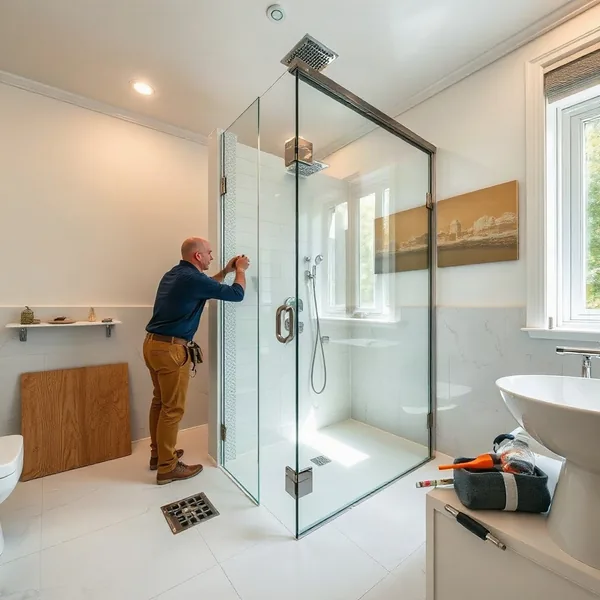
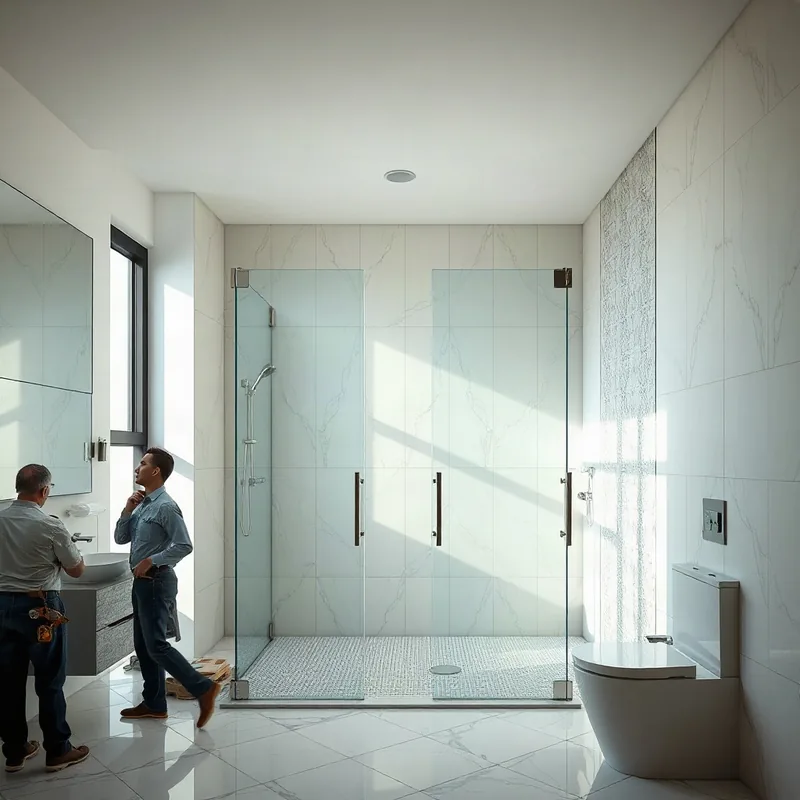
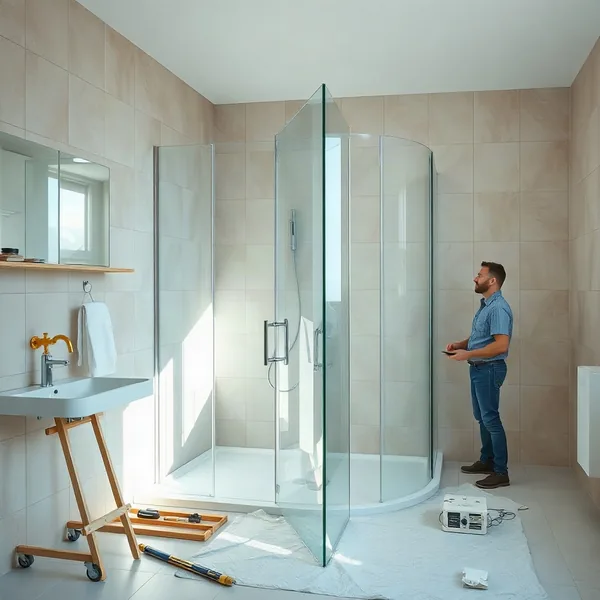
The crew arrives with the fabricated glass panel already cut, edged, and drilled, so on-site work focuses entirely on fitting and alignment rather than cutting.
Hinge fixing begins with drilling and anchoring wall plates into confirmed solid substrate — we use grade 316 stainless fixings as standard because Dubai's humidity spikes above 90 percent on summer nights, and lower-grade hardware corrodes inside enclosures within 18 months. Once the glass panel is hung and the swing arc is confirmed level, we run a continuous bead of neutral-cure silicone seal along all fixed edges and the door bottom sweep. Curing takes 24 hours before the enclosure is used. The whole process — from hinge fixing to final inspection — runs 3–5 hours for a single swing door and 5–7 hours for a double-panel enclosure.